
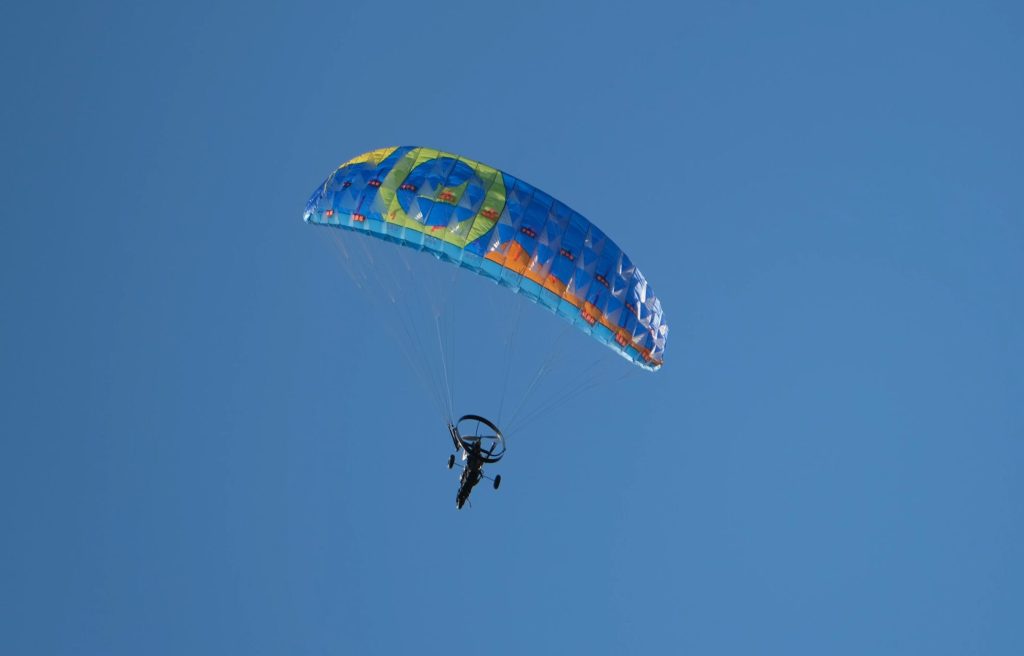
As the airdrop industry evolves, there is continuing interest in compact, lightweight, and cost-effective parafoils. Single surface parafoils are a natural fit for this need. These parafoils offer similar guidance and glide ratios to ram-air parafoils while using half the canopy material, reducing total canopy mass and simplifying construction. Like conventional ram-air parafoils, single surface parafoils are usually controlled via trailing edge deflection, which lacks direct glide slope control.
Earthly Dynamics has demonstrated glide slope control can reduce miss distances of aerial delivery systems by a factor of three by preventing overshoot on final approach using bleed-air actuation. To date, bleed-air actuation has only been demonstrated on ram-air parafoils, which have a large pressure differential between the stagnated, internal ram air, and the low pressure, upper surface. This pressure differential is the driving force for the venting of air through the bleed-air vents and the spoiling of lift on the upper surface. Single surface parafoils lack internal ram-air and therefore the efficacy of bleed air spoilers on single surface canopies has been relatively uncertain, until now.
Earthly Dynamics demonstrated the efficacy of bleed air actuation on single surface parafoils. By varying the span-wise and chord-wise locations of bleed-air vents on a single surface paragliding-style canopy and measuring the steady flight characteristics, the control authority of the spoilers is mapped. Preliminary results demonstrate that bleed-air spoilers are indeed an effective glide slope control strategy for these canopies by achieving glide slope reductions of 58%, on par with bleed-air control of ram-air canopies.